
Tesamorelin Research Applications Explained

Tesamorelin research applications sit at an interesting intersection of endocrinology, metabolism, and translational peptide science. Unlike broad-interest compounds that attract attention for hype before data, tesamorelin has a defined mechanistic identity: it is a growth hormone-releasing hormone analog studied for its ability to stimulate endogenous growth hormone signaling. That single feature gives researchers several useful entry points, especially when the goal is to model how pulsatile endocrine regulation affects fat distribution, hepatic metabolism, and downstream insulin-like growth factor 1 dynamics.
For laboratories evaluating peptide-driven metabolic pathways, tesamorelin is not especially mysterious. The value is in how it helps isolate a specific signaling axis without introducing the same profile as exogenous growth hormone administration. That distinction matters. When a research design depends on preserving upstream hypothalamic-pituitary physiology, tesamorelin can serve as a cleaner tool for studying regulated secretory responses rather than simple hormone replacement effects.
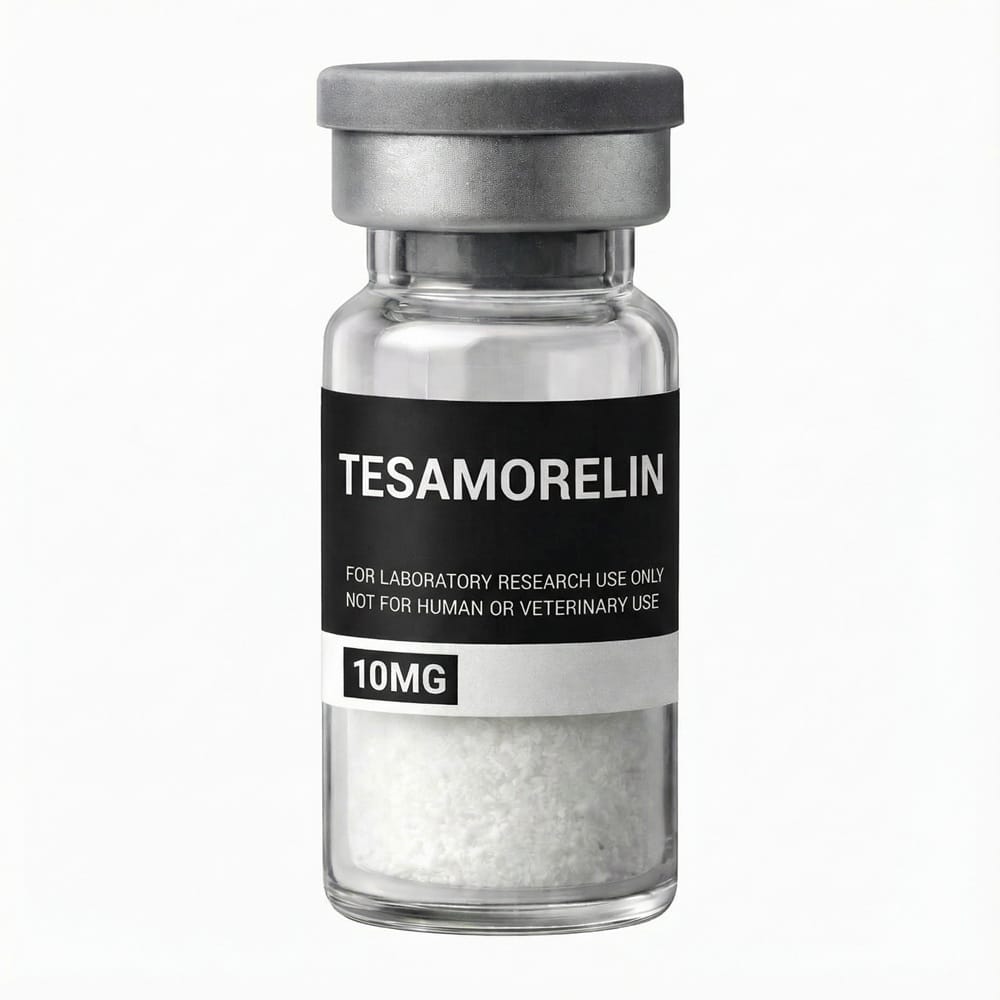
Where tesamorelin research applications are most relevant
Most tesamorelin research applications cluster around body composition and metabolic regulation. Investigators often focus on visceral adipose tissue, lipid handling, glucose homeostasis, and endocrine feedback systems. These are not interchangeable domains, even though they overlap in practice.
In body composition research, tesamorelin is useful because it allows scientists to examine whether endogenous growth hormone stimulation changes fat compartment behavior differently from direct hormone exposure. Visceral adiposity is especially important here. It is metabolically active, linked to inflammatory signaling, and associated with cardiometabolic risk in several disease models. A compound that shifts this compartment without acting as a blunt anabolic input is naturally interesting to researchers building more precise endocrine frameworks.
Metabolic studies add another layer. Growth hormone signaling influences lipolysis, hepatic glucose output, substrate utilization, and IGF-1 production. Tesamorelin offers a way to examine those relationships in a regulated fashion. Depending on the model, researchers may be less interested in gross weight change and more interested in changes in trunk fat distribution, fasting markers, liver-related endpoints, or tissue-specific metabolic responses.
Why the mechanism matters in research design
Tesamorelin acts through the growth hormone-releasing hormone receptor, stimulating pituitary release of growth hormone. That means its activity depends on an intact endocrine axis. This is one of the main reasons tesamorelin research applications require careful model selection.
If the pituitary response is impaired, the peptide may appear weak or inconsistent even when the problem is really the biological system under study. By contrast, in models with preserved responsiveness, tesamorelin can help researchers examine how upstream stimulation affects downstream outcomes over time. This is particularly relevant in comparative work where investigators want to distinguish receptor-level signaling, secretion patterns, and feedback inhibition.
There is also a practical trade-off. Because tesamorelin relies on endogenous pathways, results can be more physiologically informative, but they may also be less predictable than those seen with direct hormone administration. For some labs, that is a strength. For others, especially those screening for maximal effect size rather than pathway fidelity, it can be a limitation.
Tesamorelin research applications in adiposity and body composition models
One of the strongest areas of interest involves fat distribution rather than simple mass gain or loss. Researchers studying adipose tissue know that not all fat depots behave the same way. Visceral fat has different endocrine and inflammatory characteristics than subcutaneous fat, and those differences affect the interpretation of any peptide intervention.
Tesamorelin is therefore relevant in experiments designed to test selective changes in adiposity. A laboratory may use it to study whether stimulation of endogenous growth hormone modifies central fat accumulation, alters adipocyte signaling, or changes lipid mobilization patterns under controlled dietary conditions. These questions become more useful when combined with imaging, biomarker analysis, and hepatic measurements rather than relying on weight alone.
This is one reason tesamorelin has remained scientifically interesting. It supports a more nuanced body composition discussion. Researchers can investigate whether improvements in one metabolic compartment occur alongside neutral, beneficial, or adverse changes in another. That matters because endocrine interventions often produce mixed outcomes depending on duration, dosing framework, and baseline metabolic state.
Metabolic and hepatic research interest
A second major category of tesamorelin research applications involves liver and metabolic health. Investigators interested in fatty liver biology, insulin sensitivity, and lipid turnover often track peptides that influence fat partitioning and endocrine regulation at the same time.
The logic is straightforward. If a peptide changes visceral adiposity and growth hormone signaling, it may also affect hepatic lipid exposure and broader metabolic markers. That does not mean every study will show uniform benefits. In fact, this is an area where researchers need restraint. Growth hormone axis modulation can improve some endpoints while complicating others, especially where glucose handling is concerned.
That tension makes tesamorelin a useful research compound. It allows investigators to ask more realistic biological questions. Instead of assuming a one-direction effect, studies can examine whether the peptide improves liver-related endpoints while requiring closer analysis of glycemic effects, compensatory signaling, or treatment duration thresholds. This kind of design is more relevant to translational science than simplified before-and-after models.
Endocrine aging and catabolic state research
Tesamorelin research applications also extend into studies of age-related endocrine decline and catabolic physiology. Growth hormone pulsatility changes with age, and that shift is associated with altered body composition, reduced lean mass maintenance, and metabolic drift. A peptide that stimulates endogenous release can therefore be useful in models exploring whether partial restoration of signaling changes tissue behavior.
The important point here is that tesamorelin is not a universal proxy for youth-associated endocrine function. Aging involves multiple hormonal systems, inflammatory changes, mitochondrial alterations, and tissue-specific resistance patterns. Still, for researchers studying one part of that network, tesamorelin offers a defined intervention that can help separate growth hormone axis effects from other variables.
This has relevance in sarcopenia-adjacent research, frailty modeling, and recovery-related physiology, although the evidence base and translational meaning differ by model. Some investigators may prioritize lean mass retention and fat redistribution, while others may be focused on recovery kinetics, protein turnover, or endocrine resilience after stress exposure.
Limits and confounders researchers should account for
The most useful tesamorelin data usually comes from studies that respect its limits. One common mistake is treating all growth hormone axis compounds as functionally interchangeable. Tesamorelin is not the same as growth hormone, and it is not identical to every other growth hormone secretagogue either.
Receptor specificity, pituitary dependency, dosing schedule, and feedback regulation all shape outcomes. Investigators also need to account for baseline metabolic status. A peptide may show different effects in lean versus obese models, insulin-sensitive versus insulin-resistant systems, or younger versus older cohorts. The same issue appears in hepatic studies, where disease stage can alter how meaningful a body composition shift actually is.
Study duration matters as well. Short-term endocrine changes can look promising without translating into durable tissue remodeling. On the other hand, longer exposure can introduce adaptation, receptor desensitization patterns, or secondary metabolic effects that complicate interpretation. This is where disciplined protocol design matters more than enthusiasm.
Why tesamorelin still matters in peptide science
There is no shortage of newer compounds competing for attention, especially in metabolic research. Even so, tesamorelin retains value because it sits in a scientifically interpretable niche. It is not a vague multipathway peptide with hard-to-parse outcomes. Researchers know the principal axis involved, understand the basic endocrine logic, and can build studies around measurable downstream effects.
That makes it attractive for laboratories that care about mechanism as much as outcome. In research environments across the UAE, where biotech and translational life sciences capacity continues to expand, compounds like tesamorelin remain relevant precisely because they support targeted hypothesis building instead of trend-driven experimentation.
For platforms such as Peptide Research, that is the real point of following tesamorelin closely. Its value is not novelty for novelty's sake. Its value is that it gives serious researchers a controlled way to study how upstream endocrine modulation influences adiposity, metabolism, and tissue-level adaptation.
The next useful question is rarely whether a peptide is interesting in general. It is whether the mechanism matches the model, the endpoints are chosen with discipline, and the expected trade-offs are acknowledged before the study begins. Tesamorelin rewards that kind of thinking.